





Illustrations
Explore Whole Life, UL, VUL, IUL, disability, long-term care and annuities, with nine sample reports, product calculations and AI-assisted explanations.
67 slides · English
View presentation
01 / Overview
Connect insurance operations, reinsurance, and actuarial work on a shared platform, with governed AI and traceable decisions.
Genellipse plans a focused MVP within 6 weeks. Agree the outcome, interfaces, access, client reviewers, and acceptance criteria at the start. Use the delivered evidence to decide the next stage.
ILLUSTRATIVE WORKFLOW
Insurance
Reinsurance
Actuarial
Confirm the capabilities and configuration appropriate to your requirements.
INSURANCE EXPERTISE. ONE TRANSFORMATION PARTNER.
Explore each discipline with a detailed slideshow, an English PowerPoint and a LinkedIn-ready PDF.
Explore Whole Life, UL, VUL, IUL, disability, long-term care and annuities, with nine sample reports, product calculations and AI-assisted explanations.
67 slides · English
View presentation
Explore policyholder servicing, life claims, actuarial controls, legacy modernisation and the economics of a shrinking portfolio.
35 slides · English
View presentation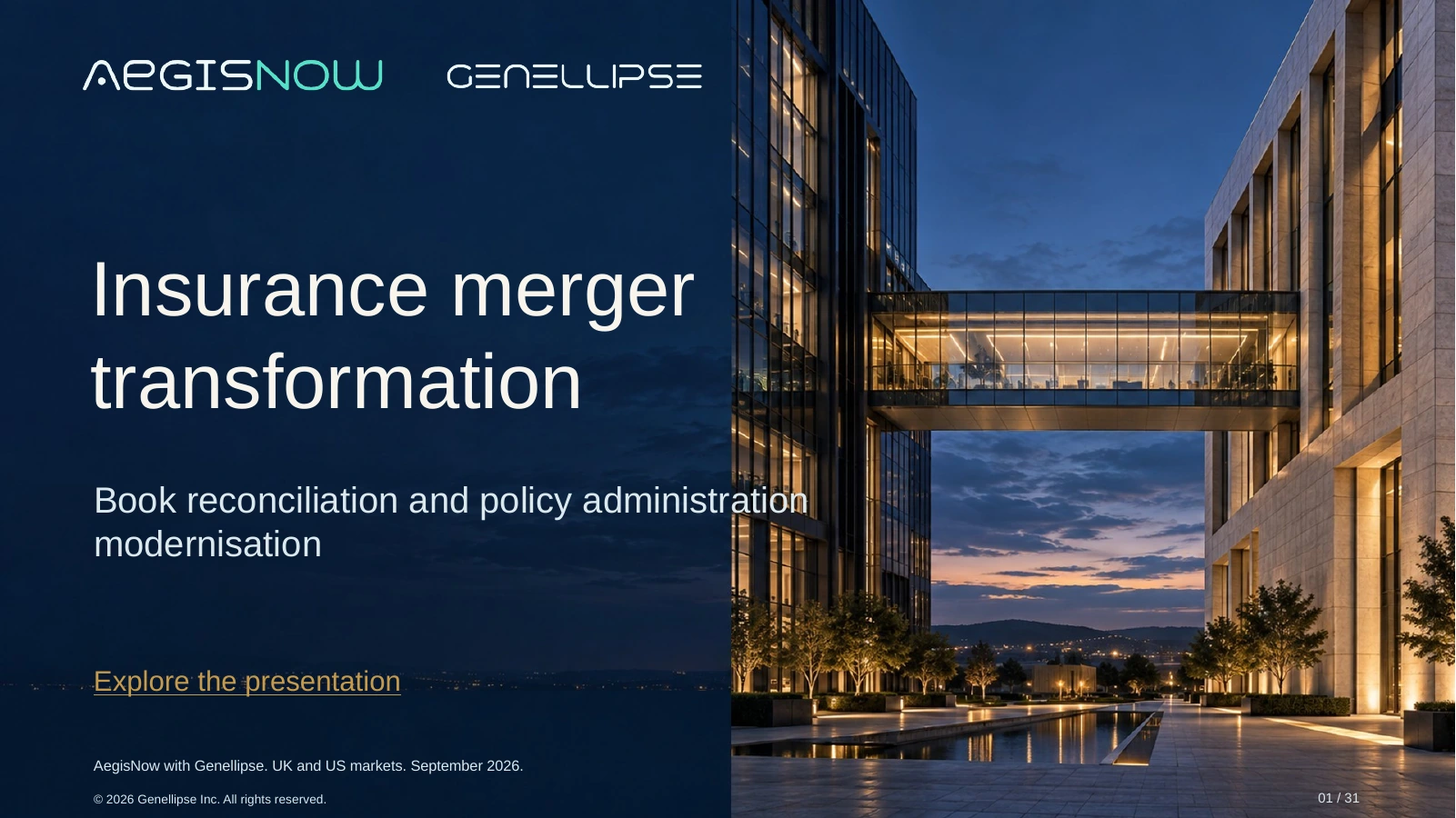
Book reconciliation, APIs and MCP, complex batch processing and controlled policy system conversion, with an illustrative cost-reduction model.
31 slides · English
View presentation
Explore delegated authority reporting for the London insurance market and Lloyd’s: binder controls, data quality, premium and claims reconciliation, AI assistance and implementation.
58 slides · English
View presentation
The executive story across insurance, reinsurance and actuarial work.
20 slides
View presentation
Underwriting, claims, servicing and legacy API enablement.
20 slides
View presentation
Treaty structures, recoveries, reconciliation and finance controls.
20 slides
View presentation
Reserving, pricing, valuation and professional governance.
20 slides
View presentationAI-assisted life insurance claims, from notification to benefit payment, with human review and a concrete risk mitigation plan.
24 slides
View presentationLife and P&C underwriting with AI assistance, reproducible pricing, human authority and risk controls.
24 slides
View presentation
AegisNow
A policy decision, a claim, a ceded recovery, and a reserve calculation are connected parts of the same business. AegisNow brings those perspectives together so operations, finance, and actuarial teams can work with shared context and review the evidence behind a result.
EXPLORE AEGISNOW
AegisNow brings underwriting, claims, policy administration, billing, and distribution together for Life and P&C carriers and MGAs. Reinsurance and actuarial modules connect ceded risk, assumptions, calculations, and review to the same operating picture.
Connect underwriting, claims, policies, billing, and customer information. Use AI assistance within defined authority and approval controls.
Organize programs and treaties, calculate cessions, track recoveries, and review counterparty exposure with the supporting records in view.
Support pricing, reserving, valuation, and capital analysis with versioned assumptions, reproducible runs, and recorded review.
INSIDE AEGISNOW
Explore the capabilities behind the platform, the work each supports, and the details to examine with your team.
Bring the core operating processes into a coordinated workflow. Connect policy and customer information with the work of underwriting, claims, billing, and distribution teams.
Model programs, treaties, layers, and counterparty participations as structured records. The cession engine distinguishes quota share, per-claim excess of loss, and aggregate stop loss rather than treating every cover the same way.
Follow a recovery from the claim that generated it through collection. Review outstanding balances and ageing alongside collateral, counterparty exposure, and concentration.
Work with loss triangles and methods including chain ladder, Bornhuetter–Ferguson, Cape Cod, and expected loss ratio. Review deterministic estimates alongside uncertainty analysis using analytic and bootstrap approaches.
Bring pricing and valuation work into the same actuarial environment. The product describes IFRS 17 measurement capabilities and capital analysis for Solvency II and NAIC RBC; evaluations should use the requirements relevant to your organization.
Actuarial runs distinguish exploratory work from production work, with source certification and recorded review. Completed calculations can be assembled into evidence packs for examination beyond the original workspace.
A WORKFLOW IN PRACTICE
An illustrative evaluation workflow: use a representative book of business to examine how information moves between teams. The steps below are a discussion guide for a demonstration, not a customer outcome.
Select the claims and policy data for the period, identify its owner, and review the quality and certification requirements for the intended calculation.
Apply the relevant treaty structures. Inspect the cession, recovery, and retained figures, including exceptions that need investigation.
Choose the method and assumption version. Compare results and uncertainty, and test whether the review team can reproduce the calculation.
Bring the supporting data, assumptions, calculation record, limitations, and approval together so a reviewer can follow the basis of the result.
YOUR EXISTING ENVIRONMENT
Begin with the policy, claims, finance, reinsurance, and actuarial systems involved in the selected process. Establish identifiers, reconciliation rules, data ownership, and decision authority before agreeing integration or migration scope. Reinsurance coverage should be evaluated against your actual treaty forms and operating needs.
FROM CAPABILITY TO APPLICATION
Insurance decisions depend on information that often sits across policy, claims, finance, reinsurance, and actuarial systems. AegisNow brings these operating areas into a shared platform so teams can review business activity alongside the assumptions and records that support it.
Follow work across submissions, underwriting, policies, claims, and billing. Identify the handoffs where teams need consistent information, a clear owner, and a documented decision.
Organize reinsurance programs and treaties alongside cessions, recoveries, and counterparty exposure. Give operational and finance teams a clearer basis for review and reconciliation.
Bring assumptions, model runs, results, and approvals into the actuarial workflow. Support pricing, reserving, valuation, and capital analysis with a record that reviewers can follow.
PLAN A USEFUL EVALUATION
Bring a representative example, the people who own it, and the requirements it must meet. Review the whole path from input to output, including exceptions and handoffs.
EVALUATE WITH CONFIDENCE
Genellipse plans a focused MVP within 6 weeks. Agree the outcome, interfaces, authorized access, client reviewers, and acceptance criteria before delivery begins.
COMMON QUESTIONS
Explore the scope, practical considerations, and a useful starting point for your team.
The platform spans insurance operations, reinsurance management, and actuarial work, with capabilities for Life and property and casualty organizations and MGAs. A demonstration should focus on the line of business and workflows relevant to your team.
An evaluation can focus on a bounded workflow, such as claims review, reinsurance reconciliation, or an actuarial reporting process. The implementation plan should identify required integrations and dependencies before a wider rollout is agreed.
Bring a representative analysis, its source data, assumptions, and review steps. Follow the path from inputs to results, including a changed assumption or exception, and assess whether reviewers can reproduce and explain the output.
TAKE A CLOSER LOOK
See the product, explore its capabilities, and find your next step.