
LATEST DISCUSSION
When the business changes, does your AI know?
The next test for enterprise AI is whether it can work within the obligations, exceptions and decisions that make a business what it is.
Imagine an insurer that has acquired a closed book of life policies. The acquisition is complete. The records have been migrated. Employees can find the documents. An AI assistant is ready to answer servicing questions.
A policyholder asks for a surrender quotation. The assistant retrieves an authentic document, quotes it correctly and produces a convincing explanation. Yet it has selected the terms of a newer product rather than those governing the policyholder’s contract.
Nothing needed to be fabricated for the answer to be wrong.
This hypothetical case exposes a deeper challenge than keeping an AI model up to date. An established business contains decisions made at different times, for different customers, under different conditions. Experienced employees spend part of their working lives reconciling those differences. They know which exception belongs to an acquired portfolio, when an endorsement changes the standard wording and when a seemingly routine request needs a specialist.
As we automate that work, we have to make those judgments explicit, testable and maintainable. Otherwise, AI can turn an unresolved organizational ambiguity into a consistent operational error.
That is the leadership issue I want to examine: how do we preserve the meaning of a business while changing the way it operates?
The answer may need the past and the present at the same time
Return to our illustrative policyholder. The policy was issued in 2008. An endorsement was added later. The book subsequently changed ownership, and the insurer introduced a new servicing procedure this year. A financial quotation must also use the relevant current account position and valuation date.
There is no single “latest version” that answers all of this.
| Part of the decision | The question that establishes its authority |
|---|---|
| Contractual entitlement | Which policy terms and applicable amendments govern this customer’s request? |
| Operational procedure | Which approved process applies to this book and this type of transaction now? |
| Financial calculation | Which authorized service, assumptions, balances and valuation date determine the amount? |
| Permission to act | Who can approve the action, and what conditions must still be satisfied at execution? |
A current servicing instruction cannot simply be assumed to change an older contractual entitlement. Equally, an old contract does not mean employees should use a retired operating procedure. The applicable legal and contractual interpretation belongs with qualified specialists; the technology must preserve and apply the rules they approve.
For this case, the policy administration system or validated calculation service should produce the quotation. AI can assemble the relevant evidence, explain the calculation’s inputs and highlight a conflict. It should not improvise a financial value from retrieved prose.
That distinction is especially important in long-duration insurance. A portfolio can stop accepting new business while its servicing, claims and reporting responsibilities continue. Modernization must carry forward the obligations of that book, including the distinctions that make it different from the insurer’s newer products. A technically successful migration can still leave that business meaning incompletely represented.
The work experienced people do between the documents
When two documents disagree, a capable employee does more than choose the more recent one. They investigate the relationship: is one a general rule and the other an authorized exception? Does one concern a different jurisdiction? Was a change approved but never implemented? Is the inconsistency a genuine defect that needs a business decision?
A system that blends those sources into a smooth paragraph can hide the very disagreement a reviewer needs to see. Fluency can remove the visible signs of uncertainty without resolving their cause.
This is why I would examine the work of experienced staff before designing the retrieval process. Ask a specialist to explain several difficult cases, including a case where the apparently obvious source was wrong. Record the distinctions they used and the evidence that supported them. Challenge informal workarounds too: long-standing practice is not automatically an approved rule.
The resulting asset is more useful than a folder of documents. It is a maintained account of which information applies to which decisions, together with the person authorized to resolve uncertainty. That knowledge can improve staff training, system conversion and operational consistency as well as AI.
The objective is not to encode every professional judgment as a rule. Some cases remain genuinely ambiguous. A good design recognizes those cases early, explains what is unresolved and gives a qualified person the evidence and authority to decide.
A merger makes the problem visible; agentic AI makes it urgent
A bank integrating an acquired business encounters a related challenge. Two customers may appear to hold the same account type while having different agreements, pricing arrangements or servicing exceptions. A consolidated customer record does not establish that their treatment should be identical.
In a hypothetical fee inquiry, an assistant might locate the acquiring bank’s current tariff while overlooking a valid arrangement retained for an acquired customer group. The remedy is to establish the governing agreement and authorized treatment, not merely refresh the tariff more frequently. Where records conflict, the case needs resolution before a response or adjustment is approved.
This has strategic implications for acquisition plans. A business case that budgets for moving records but leaves the reconciliation of meanings to frontline staff can preserve a substantial integration burden. AI investment should expose that burden and help reduce it, rather than make it less visible behind a unified interface.
The Basel Committee’s January 2026 newsletter on BCBS 239 identifies mergers, new products, fragmented data estates and data lineage as continuing implementation challenges. It is an informational discussion of risk-data practices, not a new AI requirement. Its relevance here is the connection between business change, data meaning and sustained management ownership.
Agentic AI raises the stakes because a mistaken interpretation can travel beyond an answer. A retrieval agent supplies evidence, a second agent prepares a recommendation, and a third initiates a permitted workflow. Agreement between those agents is weak reassurance if they all depend on the same inapplicable source. The system needs a common, controlled basis for deciding what evidence is eligible and which actions are authorized.
The architecture must preserve the basis of the decision
Retrieval-augmented generation, or RAG, brings retrieved information into a model’s response. It can make an answer easier to trace, but relevance alone does not establish applicability. A highly relevant paragraph can still concern the wrong contract or customer population.
Our proposed design separates four responsibilities: establishing the case, selecting applicable evidence, producing the explanation, and authorizing any action. The model can contribute within that process; it should not be responsible for granting itself access or deciding the limits of its own authority.
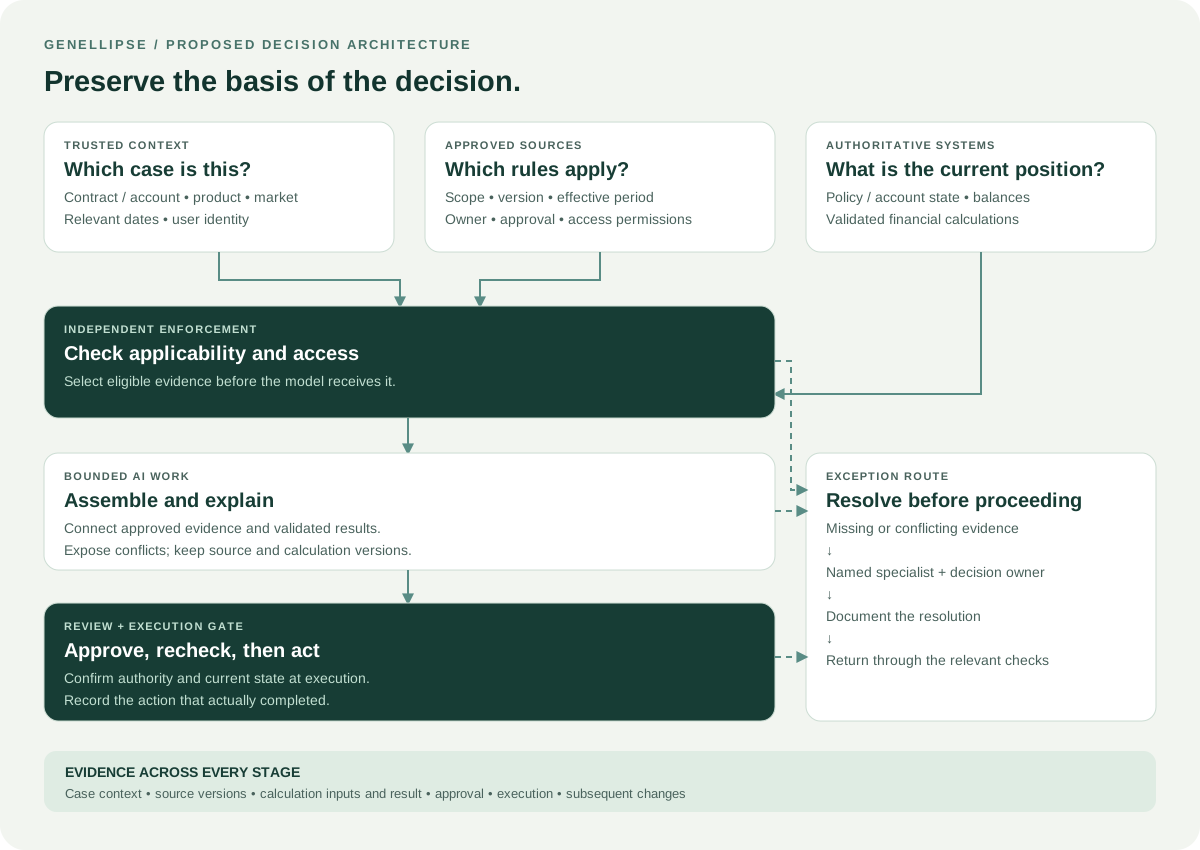
Original Genellipse diagram. Labels are in English; the accompanying explanation is available in your selected language.
Read the explanation and assumptions
Trusted case context, approved sources and authorized financial systems provide distinct inputs.
An independent eligibility check establishes applicable sources, access permissions and effective dates before bounded AI prepares an explanation.
A qualified reviewer handles exceptions. Before execution, the workflow rechecks permissions, source validity and current state. Evidence is retained across every stage.
At the start, trusted systems supply the policy or account identity, product, market and relevant dates. Approved rules determine which sources the user and workflow may access and which versions apply. Only eligible material enters the answer-generation stage. Metadata filters are one available technical mechanism; Microsoft’s search documentation describes filtering content by defined criteria. The difficult business work remains agreeing and maintaining those criteria.
Current balances and financial calculations follow their own authorized system connections. The evidence record should connect the explanation to the contract version, retrieved material, calculation result, unresolved exceptions and approval. This gives a reviewer something more useful than a transcript: a basis for understanding how the decision was reached.
Before a consequential action, the system checks again. A recommendation may wait in a queue while a source is withdrawn, an account changes or an approval expires. Permission and state must still be valid when the action executes. A conventional API and a Model Context Protocol (MCP) tool both need this discipline; neither connection type creates business authority by itself.
Changing the source means managing the consequences
Knowledge maintenance becomes an operating responsibility once answers influence work. Suppose a procedure is withdrawn at noon. The affected material may already exist in an index, a translated copy, a cached answer and several unfinished cases. Replacing the master file addresses only one part of the problem.
The organization needs to identify those dependencies, prevent inappropriate further use, verify that the change propagated and determine which pending cases need reassessment. If a decision has already been executed, changing the knowledge base does not repair it. An authorized team must assess the consequences and any corrective action.
Historical evidence should remain available under the appropriate retention and access arrangements. There are two different questions to preserve: what should govern a decision now, and what information was available when an earlier decision was made. Recording both effective dates and the dates changes entered the system helps keep those questions separate.
Someone must own the complete process. The business owner approves applicability; engineering verifies propagation; operations handles affected cases; risk, compliance and legal specialists assess consequences within their remit. A service owner must resolve gaps between these responsibilities. NIST’s Manage guidance includes post-deployment monitoring and change management; the operating arrangement described here is our proposed application.
Oversight should reflect the consequence of error. EIOPA’s August 2025 opinion takes a risk-based and proportionate approach to AI governance in insurance. My practical interpretation is that a general information response and an action affecting a policyholder’s money need different levels of evidence, approval and control. The opinion is addressed to national supervisors; it is not a certification of any platform.
Measure the cost of the whole decision
A productivity claim is incomplete if it counts faster preparation while ignoring the people who reconcile, correct and explain the result. There is also a risk of moving work: an assistant handles more requests, but specialists inherit a growing queue of difficult exceptions.
The business case should therefore measure the complete journey, including the cost of keeping knowledge usable. The following monthly example is hypothetical; its inputs are discussion assumptions, not Genellipse results or forecasts.
| Measure | Starting assumption | Evaluation target |
|---|---|---|
| Service requests | 12,000 | 12,000 |
| Requests requiring knowledge-related rework | 1,800 (15%) | 720 (6%) |
| Average rework per affected request | 18 minutes | 18 minutes |
| Total rework effort | 540 hours | 216 hours |
The difference is 324 hours of gross capacity. If maintaining sources and performing additional review require 60 incremental hours, 264 hours remain. Those hours become financial savings only if an actual expense changes. They may instead support higher volumes, shorter waiting times or better service. Implementation, platform and other operating costs still belong in the investment calculation.
The target also needs evidence that the intervention caused the improvement. Compare equivalent product groups and case types; account for changes in volumes, staffing and complexity. Check that repeat contact has not simply moved to another channel. An improving average can conceal deterioration in a small inherited portfolio.
Quality cannot be reduced to one accuracy percentage. Errors differ in consequence: a misplaced explanation and an incorrect payment instruction should not carry the same weight. Test difficult cases by contract generation, jurisdiction, exception type and action severity. Track unresolved exceptions and their age, because an assistant that defers everything may be cautious while delivering little operational value. A useful evaluation shows both where the system succeeds and where people still need capacity to intervene.
What I would ask leadership to fund—and how Genellipse can help
The first investment is time from the people who understand the business. Their participation should have a budget, a mandate and a place in delivery acceptance. Treating domain expertise as occasional support for a technology project leaves the most important decisions unresolved.
At Genellipse, we can begin with one consequential journey: servicing an acquired life book, resolving a banking exception or preparing an insurance review. We map the decisions before selecting the automation. That includes identifying the authoritative systems, the legitimate variations in treatment, the calculations and the points where someone must exercise judgment.
GeneData can provide the governed information foundation, connecting data and business knowledge with ownership and lineage. Cortex AI OS provides the environment for coordinating agents, permissions, review and activity records. In an insurance journey, AegisNow brings policy administration, insurance and actuarial context into the design, alongside the relevant existing systems and validated calculations.
GeneSecure and GeneComply support the security and control-evidence work, while GeneAnalytics can make exceptions, rework and service outcomes visible. The value is in configuring these capabilities around a shared decision process. We confirm product fit, integrations and control requirements with the partner rather than assume that every connection is already available.
For a suitably bounded scope, we target an MVP within six weeks once access, representative data and decision-makers are available. Its acceptance should demonstrate three things: a routine case handled correctly; a difficult case escalated with sufficient evidence; and a source change that reaches the affected workflow and pending work. A six-week MVP establishes evidence for the next investment; a wider book conversion or enterprise rollout requires its own plan.
This is also the business need behind our planned introduction of Cortex Blueprint in late October 2026: helping organizations connect the business outcome, responsible people, information, agents and controls when evolving their operating model. It remains a planned introduction, not a claim that the capabilities described in this article are already configured for every organization.
The durable opportunity is to make expertise easier to apply consistently, preserve it through organizational change and reduce the effort required to explain a decision. That leaves people more capacity for cases where judgment matters most.
Before approving the next expansion of AI, I would ask the team to demonstrate one decision from contract to action—and then change a rule halfway through. Can the organization identify what changes, what must remain unchanged and who is accountable for the result?
That demonstration tells a leadership team far more about readiness than another perfectly prepared answer.
FROM PERSPECTIVE TO PRACTICE