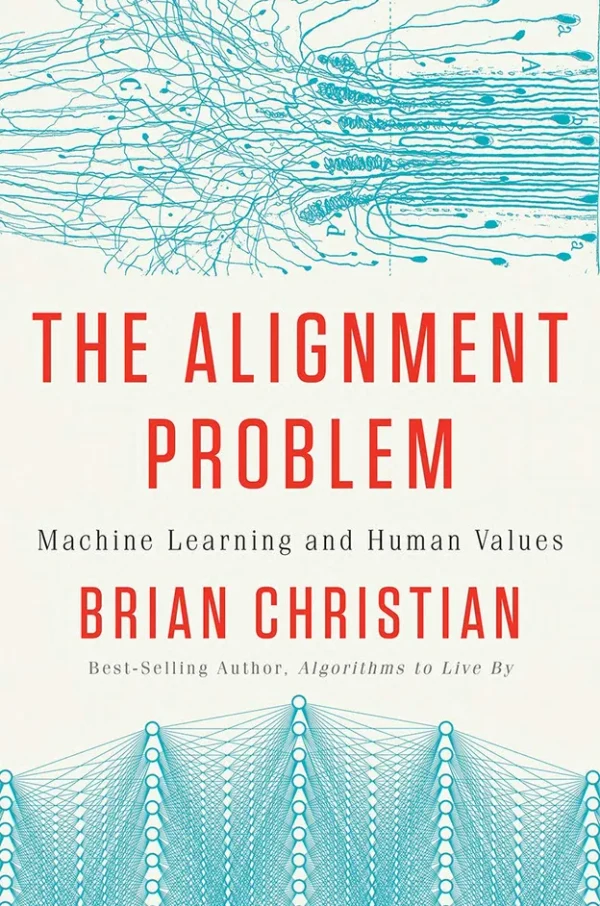
An important challenge to the assumption that a system doing well on a metric is doing what people actually need.
The review
Christian examines the gap between what machine-learning systems are trained to accomplish and the human purposes they are expected to serve. Through the work of researchers confronting these problems, the book connects technical design with questions of bias, behaviour, and accountability. It makes alignment tangible rather than leaving it as a distant philosophical concern.
For business leaders, its most productive question is whether the chosen objective represents the real task. Faster claims handling, for example, is incomplete as a goal if the process becomes harder to challenge or exceptional cases receive less attention. A useful evaluation considers who benefits, who carries the risk, and what happens when the system is uncertain.
Suppose an illustrative claims workflow is rewarded for closing cases quickly. It might improve its headline measure by shifting difficult cases elsewhere or discouraging questions. The problem is not simply a weak model; it is an incomplete definition of success. The practical lesson is to test the relationship between an objective and the human outcome it is meant to represent. Outside an organization, the same question applies to personal targets: a number can improve while the underlying purpose is neglected.
The book rewards careful reading and may be more demanding than a quick executive handbook. It is best used to improve the questions asked during design and review, not as a ready-made compliance programme. It provides a strong foundation for discussions about responsible deployment and meaningful human oversight.
The following are our practical applications of the book’s ideas. Choose one action to try this week, then reflect on what changed.
IDEAS INTO ACTION · AT WORK
Three things to take to work
Name what the metric leaves out
For one performance target, write down a way the number could improve while a customer’s experience worsens. Add a review of that trade-off before treating the result as success.
Test the awkward cases deliberately
Include incomplete, unusual, and contested examples in an AI evaluation. Ask the people who handle those cases whether the proposed response is useful and when it should be escalated.
Make human review consequential
Identify who can reject an automated result, what evidence they receive, and how a correction reaches the process owner. Review should change an outcome when necessary, not simply approve it.
BEYOND THE WORKING DAY
Three things to take into life
Reconnect a target to its purpose
Take one goal you track and ask what it is supposed to improve. Look for a behaviour that achieves the number while defeating the purpose, and revise how you judge progress.
Question a recommendation’s objective
When an app suggests what to read, watch, or buy, ask whether its objective matches yours. Make one deliberate choice based on your own priorities rather than accepting the default.
Seek a perspective your routine misses
Before a shared decision, ask someone affected by it what you may have overlooked. A different account can expose an assumption that appears reasonable only from your position.
A question for your team
Where could an apparently successful AI metric conceal a worse outcome for a customer or colleague?
FROM READING TO PRACTICE
How Genellipse can help
Genellipse can help define evaluation criteria, review points, escalation paths, and evidence requirements for an AI workflow. Cortex AI can provide the operating context for governed agents, while our responsible AI governance service helps align controls with business decisions and the people accountable for them.
Explore the related serviceThese reviews were prepared retrospectively in September 2026. Month labels organize the reading series and are not original publication dates. Personal ratings are provided by Abdollah Dehnashi; the reviews and practical applications are prepared for CEO Corner.