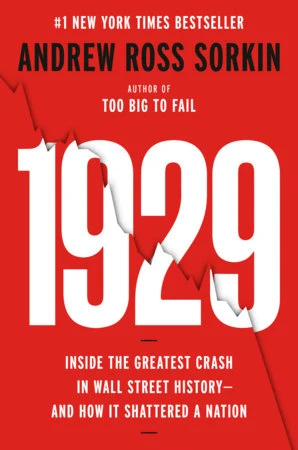
A compelling financial history that makes the human forces behind confidence, speculation, and ignored warnings difficult to dismiss.
The review
Sorkin reconstructs the Wall Street crash of 1929 through the people, decisions, and institutions caught up in the boom and its collapse. The narrative connects financial events with ambition, confidence, and the relationship between business and political power. It makes a familiar historical event feel like a sequence of choices made under uncertainty rather than an outcome that everyone should have foreseen.
Its value for a business reader is the invitation to examine how a persuasive story becomes accepted judgment. Agreement among influential people can make a weak assumption harder to challenge, particularly when recent success seems to support it. The useful lesson is not that every period of confidence must end in disaster. It is that confidence needs to remain open to evidence that would change the decision.
Imagine an illustrative board considering rapid expansion of an AI programme because early demonstrations have attracted attention. The relevant question is whether the decision rests on repeatable business results or on momentum around the technology. A constructive challenge names the assumption that could fail and the evidence needed before expanding. In personal life, the parallel is the pressure to join a popular trend simply because waiting feels like being left behind.
The book is most useful as history and as a prompt for disciplined judgment. A compelling account of an earlier crisis is not a timetable for the next one, and hindsight can make uncertainty look simpler than it was. Read it for the questions it encourages about incentives, dissent, and evidence rather than as a prediction about present markets.
The following are our practical applications of the book’s ideas. Choose one action to try this week, then reflect on what changed.
IDEAS INTO ACTION · AT WORK
Three things to take to work
Invite a reasoned challenge to the consensus
Before a major commitment, ask someone to present the strongest evidence against the preferred option. Record what would change the decision so the exercise has a consequence beyond discussion.
Inspect the incentives behind the confidence
Ask who benefits if a proposal proceeds and who carries the cost if it disappoints. Consider whether the people evaluating the evidence have enough independence to question it.
Distinguish momentum from repeatable results
Compare an encouraging demonstration with results across representative operating conditions. Agree which evidence is needed before expanding the programme, especially when external attention is creating pressure to move.
BEYOND THE WORKING DAY
Three things to take into life
Notice when popularity becomes your reason
Before joining a trend, explain what makes it suitable for your own circumstances. If the main reason is that other people are participating, identify what you still need to understand.
Write down the assumption you are relying on
For a consequential choice, name what you expect to happen and what would make that expectation wrong. Returning to the note later can improve how you recognize uncertainty.
Learn from history without forcing a prediction
When a past event seems to resemble the present, list a meaningful similarity and a meaningful difference. Use the comparison to sharpen your questions rather than assume the ending must repeat.
A question for your team
Which assumption in your current growth plan is receiving the least challenge because the recent results look encouraging?
FROM READING TO PRACTICE
How Genellipse can help
Genellipse can help partners examine the evidence behind a technology business case, establish operating baselines, and test assumptions through a focused MVP. GeneData and GeneAnalytics can support a clearer view of the information used in that evaluation. We work with decision-makers to distinguish early promise from measured outcomes and define review points before a broader commitment.
Explore the related serviceThese reviews were prepared retrospectively in September 2026. Month labels organize the reading series and are not original publication dates. Personal ratings are provided by Abdollah Dehnashi; the reviews and practical applications are prepared for CEO Corner.